

A dental SEO campaign should include six connected parts: a technical foundation, keyword research mapped to services, real service pages, local SEO and Google Business Profile management, ongoing content, and conversion tracking. Skip any one of these, and the other five end up working against a weak link.
That single-tactic habit — a few blog posts here, a Google Business Profile update there — is the most common reason dental SEO campaigns produce traffic without new patients. This guide breaks down what complete dental SEO services should include, how a campaign differs from a plan or a strategy, and what to check before judging whether one is working.
What Counts as a Dental SEO Campaign?
A dental SEO campaign is the ongoing, coordinated execution of SEO work for a practice — not a single project with a start and end date. It runs month over month, built around a strategy (the reasoning behind what gets prioritized) and a plan (the document that lays out tasks and timing).
Confusing a campaign with a one-off task is where a lot of practices lose money. A single technical audit, or three months of blog posts with nothing else changing, is a project. A real campaign connects that work to keyword research, local visibility, and reporting, so each part reinforces the others.
The 6 Core Components Every Dental SEO Campaign Should Include
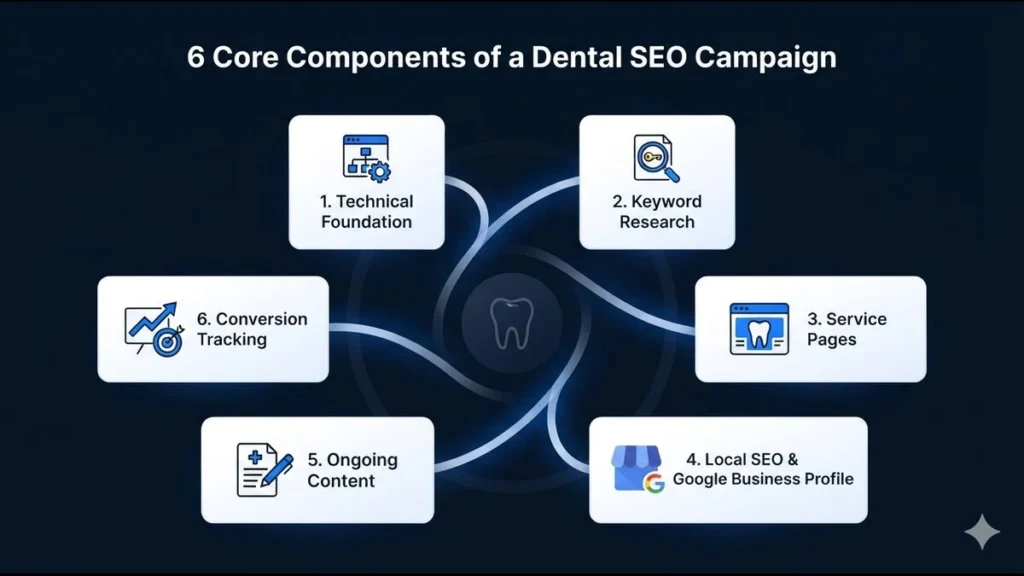
1. A Technical Foundation and Audit
Before content or link work starts, the site needs to be crawlable, fast, and usable on mobile. Google can’t rank pages it can’t properly access, and patients leave slow pages before reading a single service description.
A proper dental website audit checks indexing status, page speed, mobile usability, broken links, duplicate content, and whether structured data is in place. Skipping this step is one of the most common reasons good content still underperforms.
2. Keyword Research Mapped to Services and Locations
Generic keyword lists don’t work for a dental practice. Research needs to map specific procedures — root canals, Invisalign, implants — against location-based searches like “dentist in [city],” and separate the intent behind each one.
Dental keyword research should split transactional searches (someone ready to book) from informational ones (someone researching a procedure), because each type needs a different page: a service page for the first, a blog article for the second.
3. Real Service Pages
Every core treatment needs its own page — general dentistry, cosmetic dentistry, orthodontics, implants. Each page should answer what the procedure involves, who it’s for, roughly what it costs, and what happens at the first visit: the questions a patient has before calling.
Thin, templated service pages are a common gap. A page that only says “we offer implants, call today” gives Google little reason to rank it above a competitor’s page that actually explains the procedure.
4. Local SEO and Google Business Profile Management
For a dental practice, local visibility usually matters more than generic organic rankings, because most patients search with location intent. Google’s own guidance on local ranking points to prominence — including how many sites link to the business and how many reviews it has — as one of the signals behind local ranking, alongside relevance and distance.
A complete campaign keeps the Google Business Profile updated with accurate categories, services, hours, and photos, and includes a consistent process for requesting and responding to reviews. NAP (name, address, phone) consistency across directories belongs here too.
5. Ongoing Content Beyond Service Pages
Service pages capture people ready to book. Blog content and FAQs capture people still researching — the ones asking “how long does a root canal take to heal” or “is Invisalign worth it.” This is also where a campaign builds the topical authority that supports the whole site, including the service pages.
A dental content strategy plans this content around real patient questions instead of whatever’s easy to write, and links each article back to the relevant service or hub page so both the reader and Google can connect the two.
6. Tracking, Reporting, and Conversion Measurement
Rankings and traffic are only useful once they turn into calls, form submissions, or booked appointments. A campaign without conversion tracking can look successful on a rankings report while new-patient numbers stay flat.
At minimum, this means tracking call volume and form submissions, and — where possible — which keywords or pages those leads came from. Monthly reporting should show ranking movement and what was actually completed that month, not just a screenshot of positions.
Dental SEO Plan vs. Dental SEO Strategy vs. Campaign — What's the Difference?
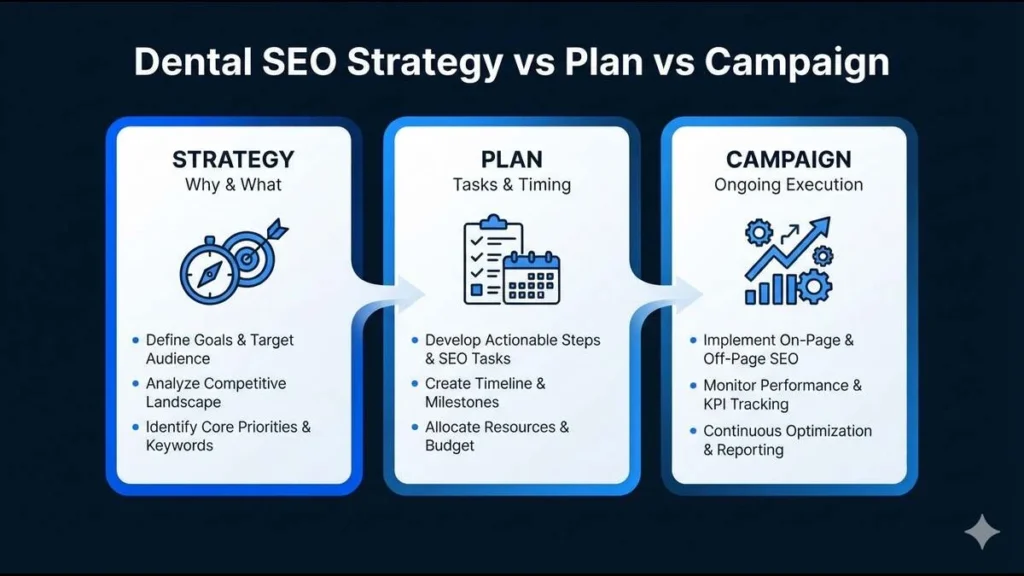
A dental SEO strategy is the reasoning: which of the six components above gets priority, and why, based on the practice’s competition, current site condition, and goals. A dental SEO plan is that strategy translated into a document — specific tasks, owners, and timing. A dental SEO campaign is the ongoing work of executing that plan, month after month.
Most of the confusion around these terms happens because an agency sells “a strategy” that’s really just a task list with no reasoning behind the priorities, or runs a campaign that’s never revisited as a strategy once it’s live. A small clinic building this in-house, rather than hiring it out, usually needs to start with the strategy step — deciding what to fix first — before writing a task-by-task plan.
How Long Before a Dental SEO Campaign Shows Results?
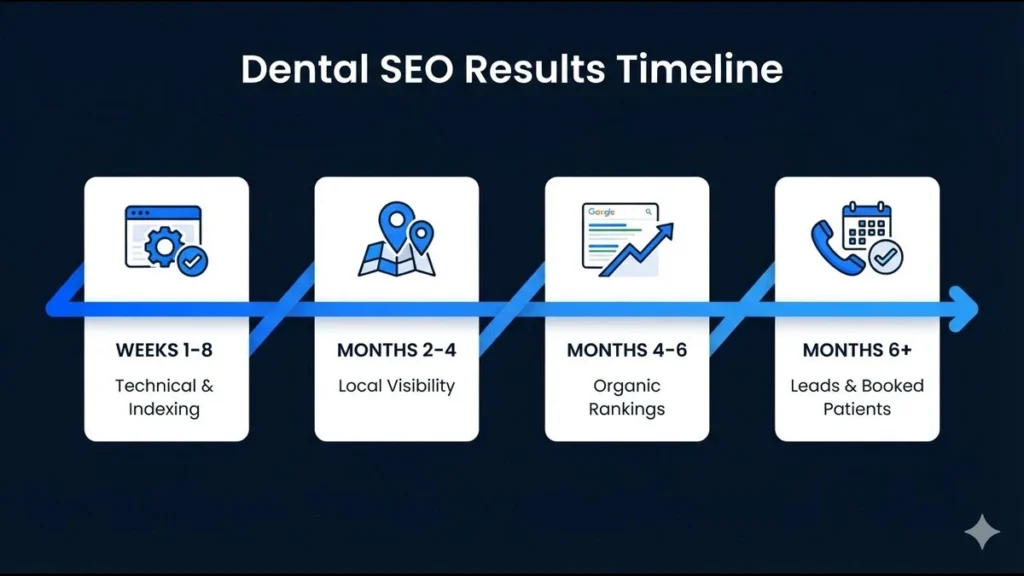
Most dental SEO campaigns need three to six months before local rankings and traffic start moving, and closer to six to twelve months for that movement to turn into a steady, measurable increase in new patients. Local pack improvements — driven mainly by the Google Business Profile work in component four — tend to show up faster than organic rankings for competitive treatment keywords.
This timeline isn’t a sales pitch for patience; it reflects how long Google needs to crawl, index, and build enough trust in a site to rank it confidently against competitors. A campaign promising major ranking changes in thirty days is either running paid ads and calling it SEO, or setting an expectation it can’t meet.
Mistakes That Quietly Sink a Dental SEO Plan
Treating Google Business Profile as a one-time setup. A profile that’s claimed and never touched again loses ground to competitors who post updates, add photos, and respond to every review. Revisit it monthly, not once at launch.
Publishing content with no internal links to service pages. Blog traffic that never connects back to a service or contact page brings visitors who read and leave. Why Some Dental Websites Get Traffic but No New Patients covers this exact gap — it’s one of the most common reasons a campaign shows good traffic numbers but flat booking numbers.
Skipping the technical audit because the site “looks fine.” A site can look fine to a visitor and still have indexing errors or slow load times keeping it out of rankings entirely. That’s why the audit comes first in the framework above, not last.
No conversion tracking from day one. Without it, there’s no way to tell whether a ranking improvement translated into a phone call — which makes it impossible to know which parts of the plan are actually paying for themselves.
How to Tell If It's Working
Look for movement in this order: technical fixes and indexing improvements first (weeks 1–8), local pack visibility and low-competition keyword movement next (months 2–4), then organic traffic and competitive keyword rankings (months 4–6), and finally a measurable increase in calls and booked appointments (months 6+). If month six arrives and nothing beyond the technical fixes has moved, that’s the point to ask what in the plan isn’t being executed — not to abandon SEO altogether.
Frequently Asked Questions
Does a dental SEO campaign cost the same as general small-business SEO?
Not usually. Dental SEO tends to cost more than generic local SEO because it needs procedure-specific content, care around medically sensitive claims, and more detailed local competition analysis. Budgets commonly range from a few hundred dollars a month for a single small clinic to several thousand for a multi-location practice in a competitive market, depending on competition, current site condition, and how much content work is needed.
Can a small clinic run this framework without an agency?
The six components can be handled in-house, but they need to be genuinely coordinated rather than tackled separately whenever there’s spare time. A solo dentist or office manager can realistically manage Google Business Profile and reviews directly; a full technical audit and steady content production usually needs dedicated time or outside help to stay consistent.
Is SEO for dental practices different from general local SEO?
Mostly in scope, not mechanics. The ranking factors — relevance, distance, prominence — are the same ones behind any local business. What’s different is the content bar: because dental information can affect a patient’s health decisions, both Google and patients expect clearer credentials and more detailed service explanations than a typical local business page needs.
Where This Leaves Your Campaign
A dental SEO campaign covering all six components — technical foundation, mapped keyword research, real service pages, active local SEO, ongoing content, and conversion tracking — has a much better chance of turning into new patients than one built around whichever tactic felt most urgent this month. Missing even one component tends to cap what the other five can achieve.
If you want to see where your current site stands against this framework, a free SEO audit will show which of these six components are already in place and which one is the priority to fix first.